The runway drops away, the nose tilts up, and a small number in the corner of the screen starts to grow: that is the first second of an AviaX flight. A Maxxi Labs creation, AviaX belongs to the crash genre: a title where you sit at the controls and trace a course across the sky, with no reels to spin.
From that moment the figure keeps rising. Nothing on screen tells you how long it will go on.
Only one control really matters, and it is the one that takes you off the trip. Timing that single choice is, in practice, the whole game.
There are no symbols to line up and no paylines to study. A round is short, one decision long, and settled the instant you act or the plane stops. A clear head matters more here than quick fingers.
The sections below cover the game and its studio, a single flight, one stake or two, the automatic exit, the shared aircraft and the published numbers, then access, safe play and short answers.
AviaX at a glance
Here are the AviaX essentials, limited to what is published. When a figure varies with the version loaded at a given casino, the table names the place to read it instead of guessing.
| Item | Detail |
|---|---|
| Type | Crash title flown from the cockpit, a sky route where reels would normally be |
| Studio | Maxxi Labs |
| Core mechanic | A multiplier that climbs with the plane's altitude, until the flight stops abruptly |
| Bets per flight | Either one or two; with a pair, the first can be banked as the second flies on |
| Auto Cash Out | You fix a multiplier beforehand, and the bet is paid out without a tap once it is reached |
| Shared flight | One plane for the whole lobby, with players vying to ride their own trip highest |
| Top win | 10,000x the amount staked on that bet |
| RTP and stake range | Printed in the AviaX rules for the build a casino has chosen |
| Release date and volatility | Listed in those same rules, with no fixed figure here |
| Demo and devices | Decided casino by casino and stated on its AviaX listing |
| Age and access | 18+ only, real money solely at licensed casinos carrying Maxxi Labs titles |
A table this compact can make the title look thin. It isn't, quite. Most of the depth in AviaX sits in how these pieces interact, especially once two stakes and a preset exit are running during one and the same round.
How a flight works
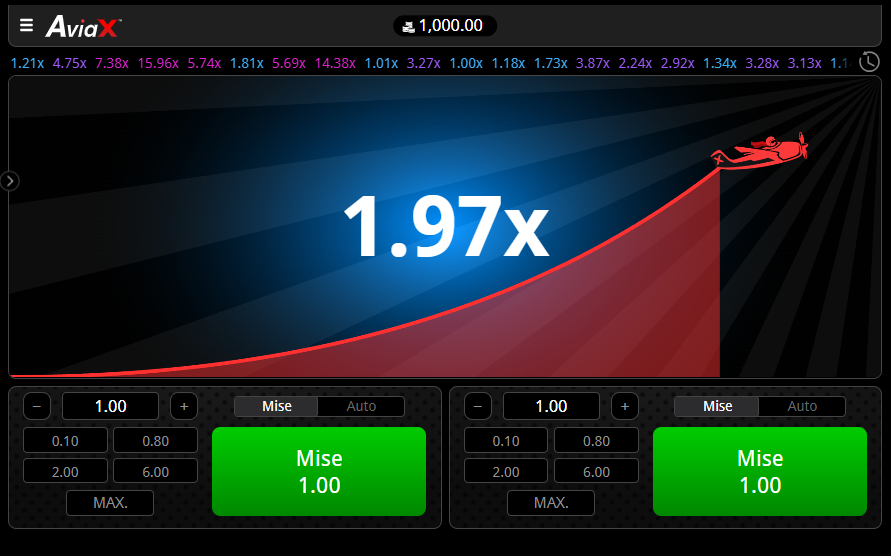
Every round begins on the ground. Bets are placed while the plane still sits on the ground. Once the aircraft is up, betting for that flight closes and the waiting begins.
Altitude drives the multiplier: the higher the plane goes, the bigger the figure. It starts low and climbs steadily, and your potential return climbs alongside it, since the payout is just your stake times whichever number is showing at the instant you collect.
Choosing the moment to cash out is up to you, and it has to happen before the flight comes to an abrupt stop. That ending gives no warning. In AviaX the plane may halt moments after lift-off or stay up for a good while, and between those extremes there is no countdown, no gauge and no hint.
Should the flight end while your bet is still riding, that stake is gone. All of it, with nothing partial handed back.
An illustration helps, using sample numbers rather than anything typical or expected. A €3 stake cashed out at x2.50 returns €7.50. Had the plane stopped a fraction earlier, those €3 would simply have vanished. Nothing in the example suggests that x2.50 is a likely, wise or recommended exit; it only shows how the arithmetic behaves.
The return grows gradually, so a little extra altitude adds a little to the payout. The risk does not grow gradually at all. You either collect at the moment you choose or lose the full amount, which turns every extra second into a trade between a slightly bigger figure and the chance of walking away empty-handed.
Each round also stands alone. Each trip is random, and no sequence hints at the point where it will stop. A string of short trips predicts nothing, and a long one is no better. Treating the last result as a clue is the oldest trap in the genre.
Cashing out in time
In AviaX, collecting is the single action that turns a rising number into money. The sequence is brief, yet each stage carries its own decision.
- Choose your stake before take-off. Size it to your session budget, not to the payout you hope for, and confirm the permitted range in the edition's own rules.
- Settle on a target, even a loose one. A figure fixed in your head before the plane moves is much simpler to stick to than one improvised halfway up.
- Watch the AviaX multiplier, not the clock. Time spent in the air means nothing by itself; only the figure at the moment you act sets the return.
- Collect when your number arrives. What you get back is the stake times the number on screen right then, and the bet leaves the round.
- Let the trip finish. After you have collected, the plane may keep climbing for others. That extra altitude is not money you lost, because it was never yours without taking the risk.
- Reset before the next round. Check your balance, ask whether your target still makes sense, and only then place a new stake.
The fourth stage is usually the hardest. A rushed tap, or a sudden itch to wait for just a bit more, is where most plans quietly fall apart.
One bet or two in AviaX
Each AviaX flight takes one bet, or two side by side. On its own, one bet makes the round a clean yes or no: you collect at your moment, or you don't.
With two running, you may bank the first and let the second keep climbing. That opens a different way to approach the same trip. A frequent approach is to give each stake its own job, collecting one early and leaving the other aloft for longer. Neither role is safer in any absolute sense. They simply fail in different ways.
A pair of bets puts a pair of stakes on the line. Should the plane stop before either is collected, both are gone. Banking the first does nothing to shield the second, and the early return may not even cover the later stake if that one goes down with the aircraft.
A second panel also doubles the speed at which a budget can move. A session that feels comfortable on a single stake each round can shrink quickly with two, all the more so when rounds arrive in rapid succession. If the budget only stretches to one stake at a time, one is the right number.
For many players, the extra bet in AviaX earns its place as a way to separate two intentions they would otherwise blur together: banking a modest return, and testing a higher target. Keeping those apart makes each decision cleaner. The flight itself treats both stakes identically.
Auto Cash Out
With Auto Cash Out, you name a multiplier ahead of time and the bet is paid the moment that figure is reached, with no action needed. It takes timing out of your hands and turns it into a decision made before anything is at risk.
- What it does: once the multiplier hits the figure you picked, that bet is settled in your favour. If the plane stops short of that point, the stake is lost as usual, because the setting never rescues a bet.
- How to set it: choose the target before take-off, for the specific stake it applies to. Pick it calmly, not in reaction to recent rounds.
- Why it helps: it removes hesitation. A preset number cannot be talked out of collecting by a climbing figure, and it cannot be rushed into collecting too soon either.
- Using it with two bets: each stake can follow its own plan. One might carry an automatic exit while you handle the other by hand, or both can run on separate preset points.
- What it does not do: it does not improve your chances. The target only defines when you leave; how long the plane stays up remains random.
- When to revisit it: between sessions, not between rounds. Adjusting the figure after every result tends to turn a plan back into guesswork.
In AviaX this tool is less about convenience than discipline. It holds you to the number you chose while your judgement was still calm.
A flight shared by every player
There is one plane for the whole lobby, and players vie to see whose ride lasts longest before they bank it. Everyone in the round watches one plane climb toward one unknown ending.
That changes the feel of AviaX more than its mechanics. Your stake, your target and your exit stay entirely your own. Another player collecting does not move the multiplier, shorten the trip or alter what you receive. The aircraft just carries on until it stops, for all of you at once.
What the common flight adds is a social pull. Seeing others hold on can make an early exit feel timid. Seeing them collect can make waiting feel reckless. Both feelings are noise.
The competition is about who goes furthest, but going furthest only counts for the person who actually collects up there. Anyone who hangs on past the end forfeits their stake on the very flight everybody else is watching, and there is nothing to share in that.
Pick your exit before glancing at anyone else. Treat the rest of the cabin as background, keep your own figure, and the communal element of AviaX stays enjoyable instead of turning into pressure.
The 10,000x ceiling
No single win can exceed 10,000x the amount staked. A limit like this shapes how the top end of AviaX should be read.
| Point | What it means |
|---|---|
| The cap | No payout goes past 10,000x the bet behind it |
| How it is measured | As a multiple of the amount placed on that bet, not as a fixed sum |
| Reading the number | The top of the range, not a picture of an ordinary round |
| How often it happens | Not published; treat it as a ceiling, never a target |
| Effect on planning | Chasing very high multipliers rarely fits a sensible budget |
| What it guarantees | Nothing; no multiplier, high or low, is ever assured |
Treat the cap like the top line of a paytable: worth knowing, rarely relevant to one evening. Planning a session around it usually means waiting far longer than a budget can afford.
RTP, volatility and stakes in AviaX
No RTP figure appears here, and that is deliberate. Launch date, return rate, volatility and betting range are all printed in the rules each casino attaches to its edition. A percentage quoted somewhere else may not match the version actually in front of you.
It takes a minute. Open AviaX at the casino, find its rules or information section, and look for the return-to-player percentage alongside the minimum and maximum stake. Note them before playing, not after a long session.
If the rules include a volatility rating, it describes how unevenly results tend to arrive over many rounds. It offers no insight into how the coming flight will behave.
Forgetting which version is running is an easy slip. Someone moving between two casinos may assume one RTP applies at both, when the rules at each could say something different. Checking every time removes that doubt.
The same applies to stakes. The range you can bet within is not universal, so the figure that suits your budget at one casino may sit outside the limits at another. Let the rules, not memory, decide what you place on each AviaX round.
Demo, devices and real stakes
Demo
Whether a free version exists is up to the individual casino, and the page it dedicates to the game will say so. Where one is offered, it lets you watch rounds, try the second bet and test Auto Cash Out without spending anything. Use it to learn how things work rather than to rehearse your luck; free rounds also feel lighter than paid ones.
Devices
Supported devices are, likewise, a casino-level matter shown on that same game page. Playing AviaX on a phone calls for a reliable signal, since everything hinges on when you tap, and a compact display leaves little margin once two bets are open.
Licensed casinos
Paid AviaX sessions run solely through licensed online operators that list Maxxi Labs games, and strictly to adults aged 18+. Maxxi Labs develops the game; the casino is the operator holding the licence, checking identity, taking deposits and paying out. Look for a valid licence, stake limits that suit you and availability where you live. Sign up, complete verification, fund the account, then look for it under instant games.
Bonus terms for AviaX come from the casino. Each operator decides its own wagering weight for crash rounds, its list of excluded titles and its stake cap under a bonus, so read them first. Ignore predictor tools, bots, signal groups, unofficial apps, sideloaded APK files and unlicensed sites: none of them knows when a random round will stop, and access should only ever run through a licensed casino.
Playing AviaX responsibly
- Set a budget before your first AviaX round and treat it as money already spent, not a sum to win back.
- Decide on a session length too. Rounds are quick, and quick rounds make an hour vanish.
- Turn on the deposit and play-time caps offered at your casino. Choose them on a quiet day, never in the heat of a session.
- Take breaks. Stepping away for a short while cools the urge to fire off the next stake.
- Keep each stake in proportion to the budget, and open the second bet only when the budget can cover two stakes per round.
- Never chase losses. Raising stakes to recover a bad run is the fastest way to deepen it.
- Keep in mind that each flight is random, with no pattern that reveals when it will end. Nothing you do can make a win certain.
- Where the casino offers self-exclusion, use it if you need a longer pause.
- If play has stopped being fun, contact an organisation of trained help professionals. Talking early beats waiting.
What to keep in mind
AviaX is built around one decision repeated over and over, and that is both its appeal and its risk. The number climbs, the plane can stop at any moment, and the stake rides on your sense of when enough is enough. Nothing in earlier rounds shows where the next one will end, and no strategy changes that. What you do control is the size of your stake, how many bets you open and the point at which you leave.
The other half lies outside the game itself. The figures that matter, from RTP to stake range, volatility and release date, sit in your casino's rules for its version, so look there rather than relying on memory or on a number spotted elsewhere. And the most valuable setting in any session is one you choose yourself: spending and time caps agreed before the first stake goes in.